
How do you build autonomous systems that are not only smart, but provably safe?
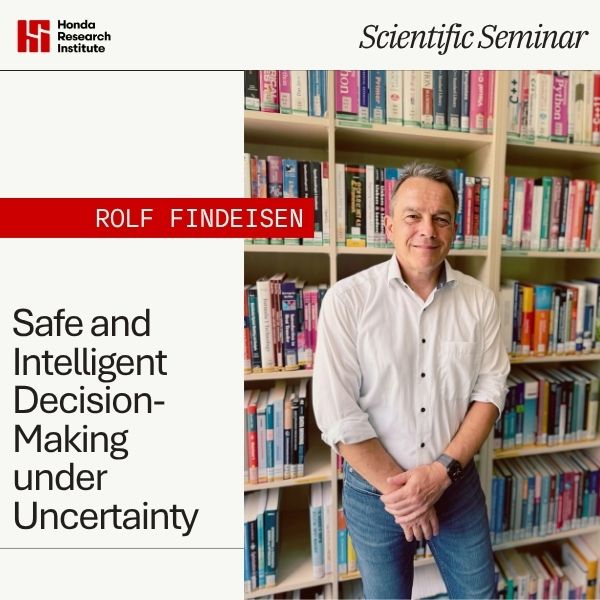 Last week, we welcomed Professor Rolf Findeisen from the Control and Cyber-Physical SystemsLaboratory at Technische Universität Darmstadt for an invited talk on fusing machine learning with predictive control.
Autonomous systems, from robots and intelligent vehicles to medical devices and energy systems, must act reliably in uncertain, dynamic environments. For instance, they need to anticipate and adapt to the behavior of humans in their environment while guaranteeing safety and stability based on control loops.
The core question driving Rolf's work: How can learned components be integrated into safety-critical systems without sacrificing formal guarantees? He introduced model predictive control as a principled framework for this challenge.
The approach builds hierarchical architectures, where fast control layers handle constraint satisfaction, and slower learning layers based on Gaussian processes, neural networks, Bayesian optimization, or foundation models improve performance over time.
Concrete applications include exoskeleton assistance, autonomous vehicles, and chemical process control. This connects directly to two of HRI-EU´s scientific focus areas: our Human Identity research, which – among other topics – explores how innovative, intelligent systems can be designed for trustworthiness and cooperativity, and our Robotics research, where safe and adaptive decision making under uncertainty is a core challenge.
We thank Rolf for an inspiring talk and insightful discussion.

